
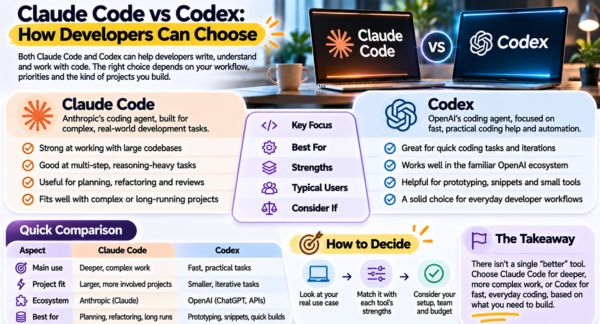
Developers now have several AI coding assistants to compare in everyday work. Claude Code vs Codex. Claude Code and Codex are coding assistants that help developers reason about and edit software projects. For people encountering Claudecode+ codex for the first time, it helps to move past the first impression. It is how the idea works, what somebody could do with it and what should be checked before drawing a conclusion.
A closer look at the concept
This becomes easier to follow once the basic mechanism is clear. Claude Code and Codex are coding assistants that help developers reason about and edit software projects. Different users may get very different results, even when they are working with the same tool. A careful explanation makes the promise easier to separate from the reality. Understanding inputs, outcomes and responsibility makes comparison much easier. A useful way to judge the topic is to compare the promise with what people can actually do today. It also helps to check dates, availability and practical requirements rather than relying on a single announcement.
Making sense of its real-world role
A developer can give each tool the same small task and compare test results and code review effort. It shows the kind of real problem a person or team would want solved. The surroundings in which it is used can change the result significantly. Everyday use comes with distractions, imperfect information and changing priorities.
What could improve
Choosing based on workflow fit is more useful than arguing over brand loyalty. Saving a few minutes on something you do every day can add up. Teams may find opportunities to work together more efficiently. Consistency matters more than one good result. The right question is whether it solves a recurring problem without creating a more difficult one elsewhere.
The other side of the story
Agent permissions, data handling and test coverage still need human control. Manufacturer details and outside reviews can help separate evidence from enthusiasm. It helps to separate available functions from features still on a roadmap. The more consequential the decision, the more important independent checks become.
Where this could go next
For readers following Claude Code vs Codex, the next useful step is to test one claim against an ordinary task. Start with the result you would expect, then check the conditions under which that result is possible. A tool is easier to judge when you have a real job for it to do. A clear benefit, an understandable limitation and dependable evidence are better measures of progress than excitement alone.