
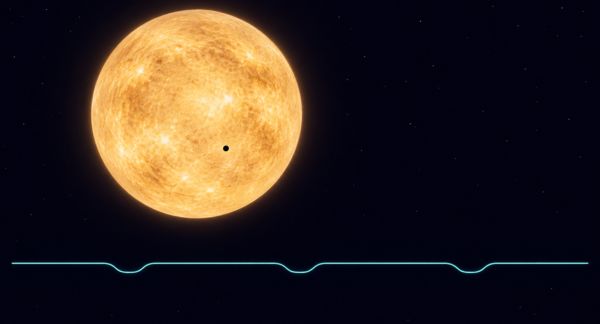
Finding a planet around another star does not always begin with a dramatic image. Often, it begins with a tiny change in brightness. Our reel told the story of developer Pavel Rabtsevich studying public observations from NASA’s TESS space telescope and noticing a repeating signal. With help from coding tools such as Claude Code and Codex, he analysed the data and tested whether the pattern could point to a planet passing in front of a star. It is an interesting example of what accessible scientific data and careful software work can make possible.
A small dip can be a clue
When a planet passes between its star and an observer, it may block a very small amount of starlight. Astronomers call this a transit. The reel described a star roughly 116 light-years away with a tiny brightness dip repeating on a cycle of about 3.18 days. A signal like that is worth investigating, but it is not proof of a planet. Other effects, including stellar activity and measurement problems, can also produce changes in brightness. Repetition helps, but confirmation takes additional checks.
Testing the pattern across years
One striking part of the story was the effort to compare observations from different years. Instead of trusting one attractive chart, the developer looked for the same timing in older data and tested predictions against information held back from the initial calculations. This kind of approach can help reveal whether a pattern is consistent or just a coincidence. Coding assistants may speed up downloading files, writing analysis scripts and producing plots, but the reasoning behind the test still matters.
Open data gives more people a chance
NASA makes many scientific datasets available for public study. That means developers, students and independent researchers can learn from real observations rather than only reading about the final discoveries. AI coding tools can lower the effort needed to build an analysis pipeline, especially for someone comfortable checking the results. They are not substitutes for astronomy expertise or scientific review. Publishing the code and data allows others to examine the method, reproduce the findings and point out possible errors.
A candidate is not a confirmed planet
The reel mentioned follow-up TESS observations scheduled for late 2026. Those dates and the status of the candidate should be checked before this story is published as current news. If the timing of a new dip matches a prediction, that would support further investigation, not automatically settle every question. The lasting lesson is about curiosity and method. Useful discoveries can begin with a small anomaly, but they become convincing through repeated tests, shared evidence and willingness to be corrected.