
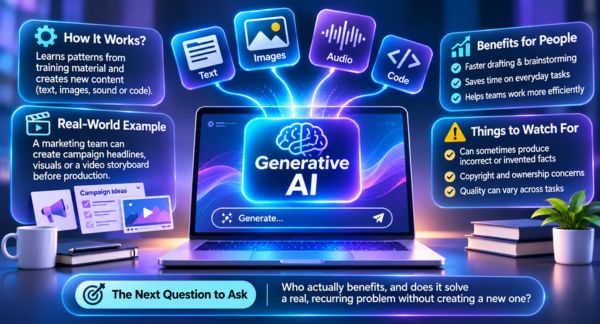
Generative AI creates new text, images, sound or code after learning statistical patterns from training material. Rather than focusing only on dramatic demonstrations, it helps Generative AI can write, draw and help with ideas. It can also make mistakes that sound remarkably confident. Their differences emerge in use. The story of generative AI, however, becomes more interesting when we look at everyday use.to understand the people, decisions and practical problems involved. That gives readers a clearer starting point for judging what matters.
What sets the idea in motion
The practical starting point is the problem being solved. Generative AI creates new text, images, sound or code after learning statistical patterns from training material. Its place in the bigger picture depends on how consistently this process works. This distinction is easy to miss when a short online demo moves quickly. It also helps to know what information goes in, what result comes out and who checks it.
An example that explains it
A marketing team could test campaign headlines or storyboard a video before production. The important part is the decision being made, not the technical label. A useful demonstration needs to resemble the setting where it will actually be used. A promising first attempt still needs to hold up across less predictable situations.
Potential benefits for people
Drafting and brainstorming become faster when people treat outputs as starting points. Small everyday gains may matter more than a single dramatic demonstration. For organisations, the impact may be just as much about workflow as technology. Any such benefit still needs to hold up during regular use. The right question is whether it solves a recurring problem without creating a more difficult one elsewhere.
Invented facts, copyright concerns and uneven quality can affect publication. Try to find evidence of what has been demonstrated, not only what has been announced. Future promises and tools available today should not be treated as identical. High-stakes uses deserve closer scrutiny before anyone depends on a result.
The next question to ask
The conversation about generative AI is likely to keep evolving, but a sensible first question remains the same: who actually benefits? Look for examples that show what changes for the user, not just which new feature has arrived. Pay attention to the gap between a product announcement and a routine someone can repeat. That distinction makes it easier to decide whether a development deserves further interest.