
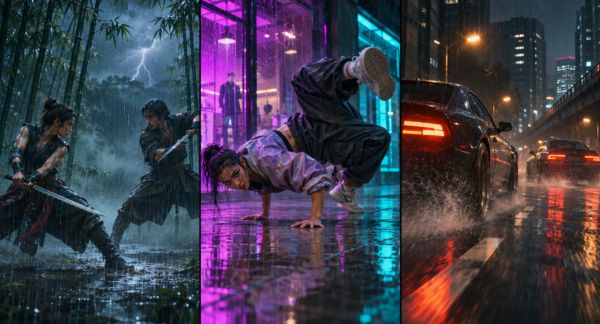
Can an AI-generated sword fight feel like part of a film? What about a dance routine on a wet city street or a tense car chase at night? RepuNEXT TV’s Higgsfield AI reel did not just describe the possibilities. It showed three scenes created as a practical experiment. That made the video more useful than a list of features because viewers could see the kinds of shots the team was trying to achieve. The test also raises a fair question for anyone interested in AI video creation: how do you turn an impressive short clip into a sequence people actually want to watch?
A Sword Fight Is About More Than Sparks
The first demonstration placed a fight in a rainy bamboo setting. Lightning, weapon impacts and energetic movement gave it a strong atmosphere. But believable action depends on the direction of each strike and the position of the characters between shots. If a sword suddenly changes hands or a performer moves through impossible positions, viewers notice. AI can produce striking moments, yet a creator still has to choose the takes that connect logically. Good editing can build excitement while avoiding cuts that make the action hard to understand.
The Dance Scene Tests Rhythm
The second scene used a neon-lit city setting and breakdance-style movement on wet ground. Dance clips bring different challenges from fight scenes. The body must follow a clear rhythm, feet need contact with the ground and movement should look continuous. Even when individual frames look attractive, timing can feel awkward if the character changes pose suddenly. Music and shot length play a major part in the finished effect. A useful test is to watch the clip without the music first, then see whether the movement still feels convincing.
A Car Chase Needs a Sense of Place
The third sequence moved towards night-time racing, with close-ups of the driver, gear shifts and rain-soaked streets. Details like these help build tension, but a chase works only when the audience can understand direction and distance. Establishing shots, reaction shots and consistent lighting can make separate generated clips feel like one event. This is where editing becomes as important as generation. Instead of making every shot more dramatic, it is often better to leave a little room for viewers to understand the action.
What We Learned From the Experiment
The Higgsfield AI showcase suggests that small teams can now test visual ideas that once felt out of reach. It does not mean production becomes effortless. Prompt design, visual selection, audio work and continuity checks still take time. The strongest result is not necessarily the one with the most effects. It is the one that supports the scene’s purpose. AI can help generate possibilities, but the finished video depends on the choices made after generation.