
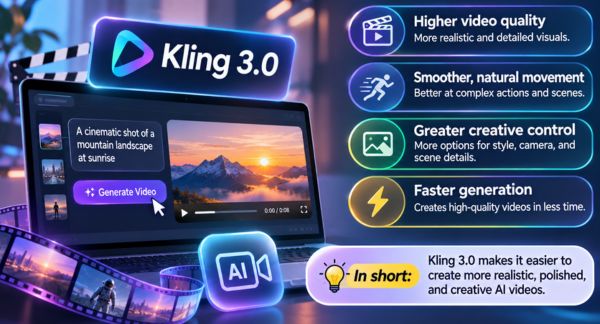
AI video tools are moving quickly, which makes it worth checking what each new version actually adds. Kling 3.0. Kling Video 3.0 adds native audiovisual output and features designed for multi-shot sequences. For people encountering Kling 3.0 for the first time, it helps to move past the first impression. It is how the idea works, what somebody could do with it and what should be checked before drawing a conclusion.
A closer look at the concept
This becomes easier to follow once the basic mechanism is clear. Kling Video 3.0 adds native audiovisual output and features designed for multi-shot sequences. Different users may get very different results, even when they are working with the same tool. It helps to see the process in action before making a judgement. Understanding inputs, outcomes and responsibility makes comparison much easier.
Making sense of its real-world role
A team can test storyboard transitions and character continuity for a short promotional clip. What matters is whether it solves the problem someone actually has. A first-time user and an experienced professional may need very different things. Routine use introduces constraints that short demonstrations rarely show.
What could improve
AI video is becoming more useful for planning as well as final visual experiments. Saving a few minutes on something you do every day can add up. Teams may find opportunities to work together more efficiently. Consistency matters more than one good result. Before relying on a new feature, check what its maker actually says it can do. A feature that helps one person might offer little value to another. Asking what can be repeated is often more revealing than asking what looks impressive.
The other side of the story
Complex movement and identity consistency still need checks before public use. Checking the official explanation against hands-on tests is a good starting point. An announced feature is not always available to use immediately. The more consequential the decision, the more important independent checks become.
What comes after the headline
For readers following Kling 3.0, the next useful step is to test one claim against an ordinary task. Start with the result you would expect, then check the conditions under which that result is possible. A tool is easier to judge when you have a real job for it to do. A clear benefit, an understandable limitation and dependable evidence are better measures of progress than excitement alone.