
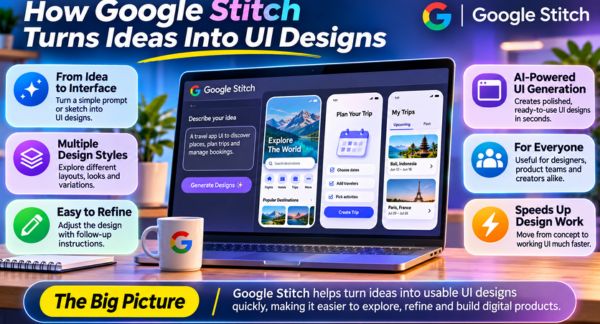
A rough idea for a website can be simple to explain and surprisingly difficult to design. Google Stitch. Google Stitch helps users create and refine interface ideas through natural-language prompts and a visual design canvas. For people encountering Google Stitch for the first time, it helps to move past the first impression. It is how the idea works, what somebody could do with it and what should be checked before drawing a conclusion.
A closer look at the concept
Google Stitch helps users create and refine interface ideas through natural-language prompts and a visual design canvas. Different users may get very different results, even when they are working with the same tool. A name on its own cannot explain whether the experience is genuinely useful. Understanding inputs, outcomes and responsibility makes comparison much easier.
Making sense of its real-world role
A founder can describe a booking page and experiment with layouts before development begins. The example also brings the discussion closer to familiar routines. Whether it works well often depends on the conditions around the user. What looks effortless in a presentation can be more complicated during everyday work.
What could improve
Designers and developers can collaborate on an early direction more quickly. Saving a few minutes on something you do every day can add up. Teams may find opportunities to work together more efficiently. Consistency matters more than one good result. The right question is whether it solves a recurring problem without creating a more difficult one elsewhere. Before relying on a new feature, check what its maker actually says it can do. A feature that helps one person might offer little value to another. Asking what can be repeated is often more revealing than asking what looks impressive.
The other side of the story
Generated screens still need accessibility, content and real-user testing. The strongest explanations make it clear where documented features end and predictions begin. Readers should watch for the gap between a prototype and a reliable public release. The more consequential the decision, the more important independent checks become.
Where this could go next
For readers following Google Stitch, the next useful step is to test one claim against an ordinary task. Start with the result you would expect, then check the conditions under which that result is possible. A tool is easier to judge when you have a real job for it to do. A clear benefit, an understandable limitation and dependable evidence are better measures of progress than excitement alone.